
The Overnight Habit That Could Be Harming Your Gums
It’s the end of a long day. You brush, wash your face, and climb into bed—but your dentures stay in. It feels harmless, maybe even more comfortable than fumbling with a denture cup in the dark. But if this is your nightly routine, you’re not alone, and you’re also not doing your gums any favors.
At Algoma Family Dentistry, patients ask us about this more than almost anything else related to denture care. The short answer: no, you shouldn’t sleep in your dentures. The longer answer is more interesting—and it’s worth understanding exactly what’s happening in your mouth while you sleep, because it explains why this one small habit can make such a big difference in how long your dentures last and how healthy your gums stay.
Dr. Daniel Fama and Dr. Pattie Sigl, your dentists in Algoma, WI, walk through what actually happens when dentures stay in overnight, why removing them matters more than most patients realize, and how to build a nightly routine that protects both your gums and your investment.
Have any questions or need to replace your dentures? Call our Algoma dental office at (920) 487-2733 to make a dental appointment today!
What Actually Happens to Your Gums Overnight
Your gum tissue isn’t built to be covered around the clock. During the day, saliva naturally washes across your gums, and your tongue and cheeks provide a steady, low-level massage every time you eat, talk, or move your mouth. That constant circulation and cleansing action keeps the tissue healthy.
A denture base sits directly against that same tissue and blocks a lot of that natural cleansing. Keep it there for 16, 18, or 24 hours straight, and a few things start to happen:
- Reduced blood flow. The soft tissue under a denture gets compressed for hours at a stretch, which limits circulation to the area. Gum tissue needs that circulation to stay healthy and to recover from the everyday wear of chewing and talking.
- Bacterial and yeast buildup. Saliva has natural antibacterial properties, but a denture sitting against the gums traps moisture, food particles, and plaque against the tissue instead of letting saliva flush it away. This is one of the most common paths to a fungal infection dentists call denture stomatitis—irritated, sometimes swollen tissue underneath the denture that can be uncomfortable and, left untreated, harder to fully resolve.
- Increased risk of bone changes. Your jawbone relies on some stimulation and rest cycles to stay stable over time. Round-the-clock denture wear doesn’t give your gums and underlying bone the same recovery window they’d get with nightly removal.
None of this means dentures are bad for your mouth—it means they’re designed to be worn, cleaned, and rested on a cycle, the same way you wouldn’t wear the same pair of shoes 24 hours a day without ever letting them air out.
The Research Behind the Recommendation
This isn’t just a preference dentists have—it’s a well-documented recommendation. Studies on denture wearers have repeatedly linked continuous, all-day-and-night denture wear with a higher rate of denture stomatitis and other oral tissue irritation compared to patients who remove their dentures nightly. The pattern is consistent enough that “remove your dentures at night” is standard guidance across dental associations, not just something individual practices recommend.
The mechanism makes sense once you look at it: it isn’t one specific bad night that causes a problem; it’s the cumulative effect of the tissue never getting a real break. Gum tissue, like skin under a bandage, needs periods of open air and normal fluid movement to stay resilient.
Why Removing Your Dentures at Night Matters for Your Long-Term Oral Health
Taking your dentures out before bed isn’t just about your gums today—it protects several things at once:
- Healthier gum tissue. Nightly removal gives your gums a real recovery window, which lowers your risk of irritation, sore spots, and infections like denture stomatitis.
- Better breath and a cleaner mouth. Bacteria that build up under a denture worn around the clock don’t just affect your gums—they contribute to odor and an unpleasant taste that’s hard to shake even with brushing.
- A longer-lasting denture. Dentures that soak overnight in water or a denture-cleansing solution stay properly hydrated. Acrylic dentures that dry out, even briefly and repeatedly, can become more prone to warping, cracking, or losing their precise fit over time—which means more adjustment visits and a shorter lifespan for your appliance.
- Fewer emergency visits. Patients who develop denture stomatitis or persistent sore spots often end up needing an unplanned appointment to treat the irritation before we can even talk about adjustments or a reline. A simple nightly habit heads that off.
A Simple Nightly Denture Care Routine
If sleeping in your dentures has been your habit, the fix doesn’t require an overhaul—just a short routine before bed:
- Remove your dentures after your last meal or snack of the day.
- Rinse off loose food particles under running water.
- Brush gently with a denture-specific brush and a non-abrasive denture cleanser—regular toothpaste is often too abrasive and can create tiny scratches where bacteria collect.
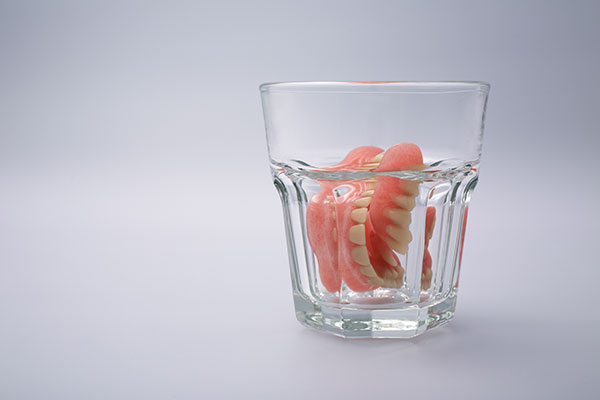
- Soak overnight in water or a denture-cleansing solution recommended by our team so the acrylic stays properly hydrated and any remaining bacteria are addressed.
- Clean your gums, tongue, and any remaining natural teeth with a soft-bristle brush before bed, since your mouth still needs its normal oral hygiene routine even without the denture in.
- Rinse thoroughly before placing your dentures back in the next morning.
This whole denture care process takes just a few extra minutes, but it’s one of the most effective things you can do to protect both your gum health and the dentures themselves.
What If You Forget Some Nights?
Life happens, and the occasional night where you fall asleep before remembering is not going to undo months of good habits. What matters is the pattern over time. If you notice ongoing redness, soreness, a burning sensation, or an unusual taste that doesn’t go away, that’s worth bringing to our attention—it could be early denture stomatitis, and it’s much easier to treat early than after it’s had time to develop.
When It’s Time to See Your Algoma Dentist
Beyond your nightly routine, a few signs mean it’s time to schedule a visit rather than wait for your next regular checkup:
- Persistent redness, swelling, or soreness under your denture
- A denture that feels looser than it used to or shifts while eating or talking
- Visible cracks, chips, or wear on the denture itself
- A burning sensation on the roof of your mouth or gums
- Difficulty chewing foods you used to manage comfortably
Any of these can usually be resolved with an adjustment, a denture reline, or a straightforward treatment for irritated tissue—but they’re much easier to address before they become bigger problems.

Ready for a Denture Checkup? Schedule With Your Algoma, WI, Dentist Today
Whether you’ve been sleeping in your dentures for years and want to turn things around, or you’re just noticing some soreness or looseness you’d like a second opinion on, Dr. Daniel Fama, Dr. Pattie Sigl, and the team at Algoma Family Dentistry are here to help. As experienced Algoma dentists, we offer denture adjustments, relines, and full evaluations to keep your smile comfortable and functional for years to come.
Call (920) 487-2733 to schedule your denture checkup, or reach out online. We welcome patients in Algoma, Bruemmerville, Forestville, and Alaska, WI, at our office at 1421 Lake St., Algoma, WI 54201.